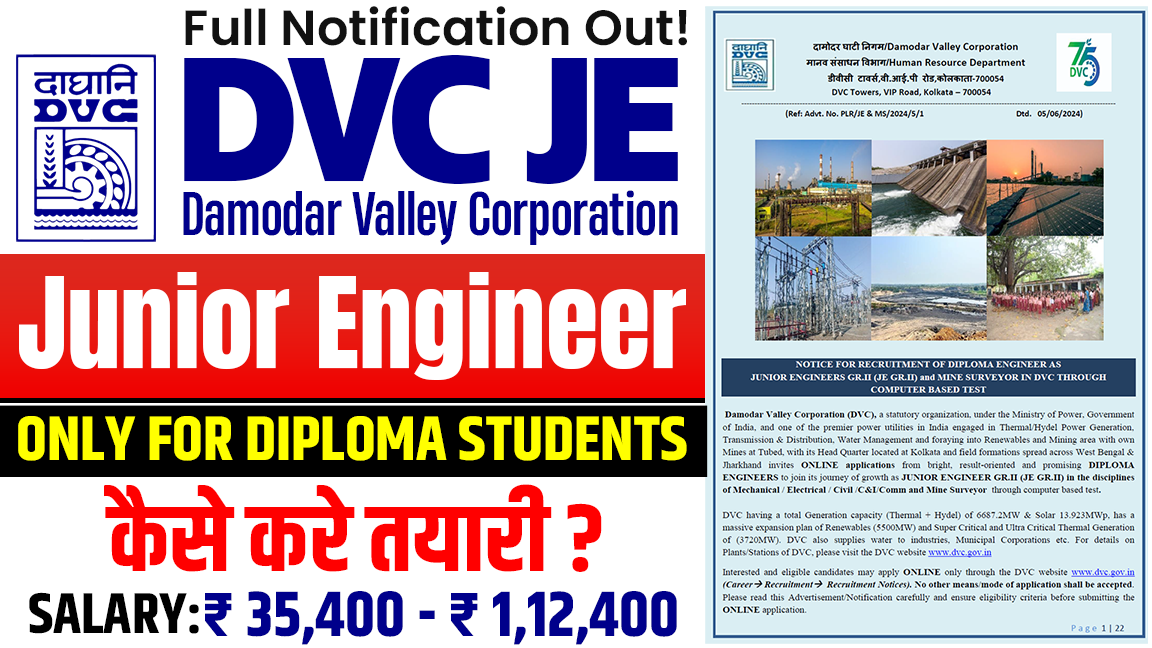
✅Damodar Valley Corporation Junior Engineers GR.II (JE GR.II) 2024
Application Date: 05/06/2024 to 04/07/2024 (Till 23:59 hrs)
Apply Link: Click here for Official Website
🎟️Exam Pattern
a. Pattern of question paper: The question paper will be bilingual i.e. both in English and Hindi, except the test of English knowledge(objective). All the questions will be objective type and shall have 4 options of which one option will be correct.
b. Duration of the computer-based test – Total duration would be 2 hours comprising of the General Aptitude Test (GAT) and Technical Knowledge Test (TKT)
c. No. of questions in each part i.e. in General Aptitude Test (GAT) and Technical Knowledge Test (TKT) - There will be 30 numbers of General Aptitude Test (GAT) and 70 numbers of questions in Technical Knowledge Test (TKT) and. Thus, there will be 100 numbers of questions.
d. Marks of each question and total marks of the question paper – Each question would carry 1 mark and the total marks of the paper (General Aptitude and Technical Knowledge) would be 100.
e. Negative marking - There will be a negative marking of 0.25 mark for each wrong answer. However, no mark will be deducted for not attempting the question by candidate.
🔴Syllabus for General Aptitude Test (GAT):
A. General Intelligence & Reasoning: The Syllabus for General Intelligence would include questions of both verbal and non-verbal types. The test may include questions on analogies, similarities, differences, space visualization, problem-solving, analysis, judgment, decision-making, visual memory, discrimination, observation, relationship concepts, arithmetical reasoning, verbal and figure classification, arithmetical number series, etc. The test will also include questions designed to test the candidate’s abilities to deal with abstract ideas and symbols and their relationships, arithmetical computations, and other analytical functions.
B. General Awareness: Questions will be aimed at testing the candidate’s general awareness of the environment around him/ her and its application to society. Questions will also be designed to test knowledge of current events and of such matters of everyday observations and experience in their scientific aspect as may be expected of any educated person. The test will also include questions relating to India and its neighboring countries especially pertaining to History, Culture, Geography, Economic Scene, General Polity and Scientific Research, etc.These questions will be such that they do not require a special study of any discipline.
C. General English: English Language & English Grammar. Narration, Voice, Basic Sentence Patterns. Transformation of Sentences, Determiners and Preposition, Tenses, Prefix, Suffix, Parts Of Speech-Common errors (Noun, Pronoun, Articles, Adverb, Punctuation, Preposition etc.), Modals, Phrases, Idioms, Vocabulary
⚡Syllabus for Technical Knowledge Test (TKT) for Electrical
A. Basic Electrical Engineering concepts: -
➢ Concept of Potential difference. Current and resistance. Ohm’s law, insulation resistance. Kirchhoff’s law,
➢ A.C. Fundamentals: Sinusoidal voltage and currents., concept of cycle period, frequency, instantaneous, peak, average, r.m.s. values, peak factor, and form factor, phase difference, lagging, leading and phasor representation.
➢ A.C circuits of pure resistance, inductance and capacitance and corresponding voltage-current phasor diagrams. Basics of series and parallel R-L, R-C, R-L-C circuits.
➢ Concept of active and reactive power and power factor.
➢ Polyphase AC circuits: Concept of three-phase supply and phase sequence. Balanced and unbalanced loads
B. Electrical Machines under Powerhouse: -
➢ Generator (basic principle & philosophy)
➢ Motor (basic principle & philosophy)
➢ Basic Electrical Protection of Generators and Motors
➢ Testing of Generators & Motors
➢ Switchgears
C. Transmission & Distribution System: -
➢ Transformers
➢ Circuit Breakers
➢ Other switchyard equipment (CT, PT, CVT, LA, Wave Trap, Isolators, Insulators, BusBar, Conductor etc.)
➢ Basic Testing of transformers, Circuit breakers, CT PT etc.
➢ DC System including Battery Bank
➢ Basic Electrical Protection philosophy of Transmission Line & Equipment such as Transformer etc.
D. Metering System
➢ Energy Meter (Basic principle of single and 3-phase energy meter)
➢ ABT meter